Cabinet Design for Hobbyists: How to Plan Your Build Before You Touch Wood

There is a moment every hobbyist knows. You have watched the YouTube videos, browsed the lumber prices, maybe even sketched something on graph paper. And then you walk into your kitchen or garage and realize: you have no idea how this is actually going to fit together. That gap between "I want to build cabinets" and "I have a real plan" is where most projects go sideways — before a single board is cut.
Why Planning Matters More Than Skill
Skilled woodworking can fix a lot of problems. A bad plan cannot be sanded down or recut. If your measurements are off, if you did not account for the toe kick depth, if the upper cabinets end up three inches too wide for the range hood — you are not fixing that with a hand plane.
The expensive mistakes hobbyists make are almost never about technique. They are about design: wrong dimensions, poor spacing, not visualizing how components interact. A seasoned cabinetmaker knows this, which is why they spend real time planning before they spend real money on material.
The Software Problem
Professional cabinet design software is powerful. It is also built for people who use it every day. The learning curve is steep, the interfaces are dense, and half the features assume you already know the vocabulary: face frame versus frameless, inset versus overlay, standard versus full-height.
If you are building one kitchen in your lifetime, spending weeks learning enterprise software is not a trade-off that makes sense. So most hobbyists fall back on graph paper, spreadsheets, or rough sketches. A flat drawing does not tell you what the finished room actually looks like. A spreadsheet will not catch the corner cabinet that cannot open once the adjacent door is installed.
What a Good Plan Actually Includes
Before you buy lumber, a solid cabinet plan should answer a few concrete questions:
- What are the exact dimensions of every cabinet — width, height, depth?
- How does each piece relate to the others? Where do the gaps, fillers, and seams fall?
- Does the layout account for appliances, vents, plumbing, and trim?
- What does it look like from the front, the side, and in the room as a whole?
- How much material do you actually need?
That last one is where hobbyists consistently overspend or under-order. Without a precise plan, you are guessing — and lumber is not cheap.
A Different Approach
Cabora was built around a straightforward idea: cabinet design should not require professional training to use. If you can describe what you want to build — room dimensions, cabinet types, door styles — you should be able to see a real layout, catch your mistakes early, and walk into the shop with a plan you trust.
For hobbyists, that means the planning phase gets shorter, your material estimates get tighter, and the surprise-in-the-shop moments get rarer. You can try Cabora for free at cabora.ai.
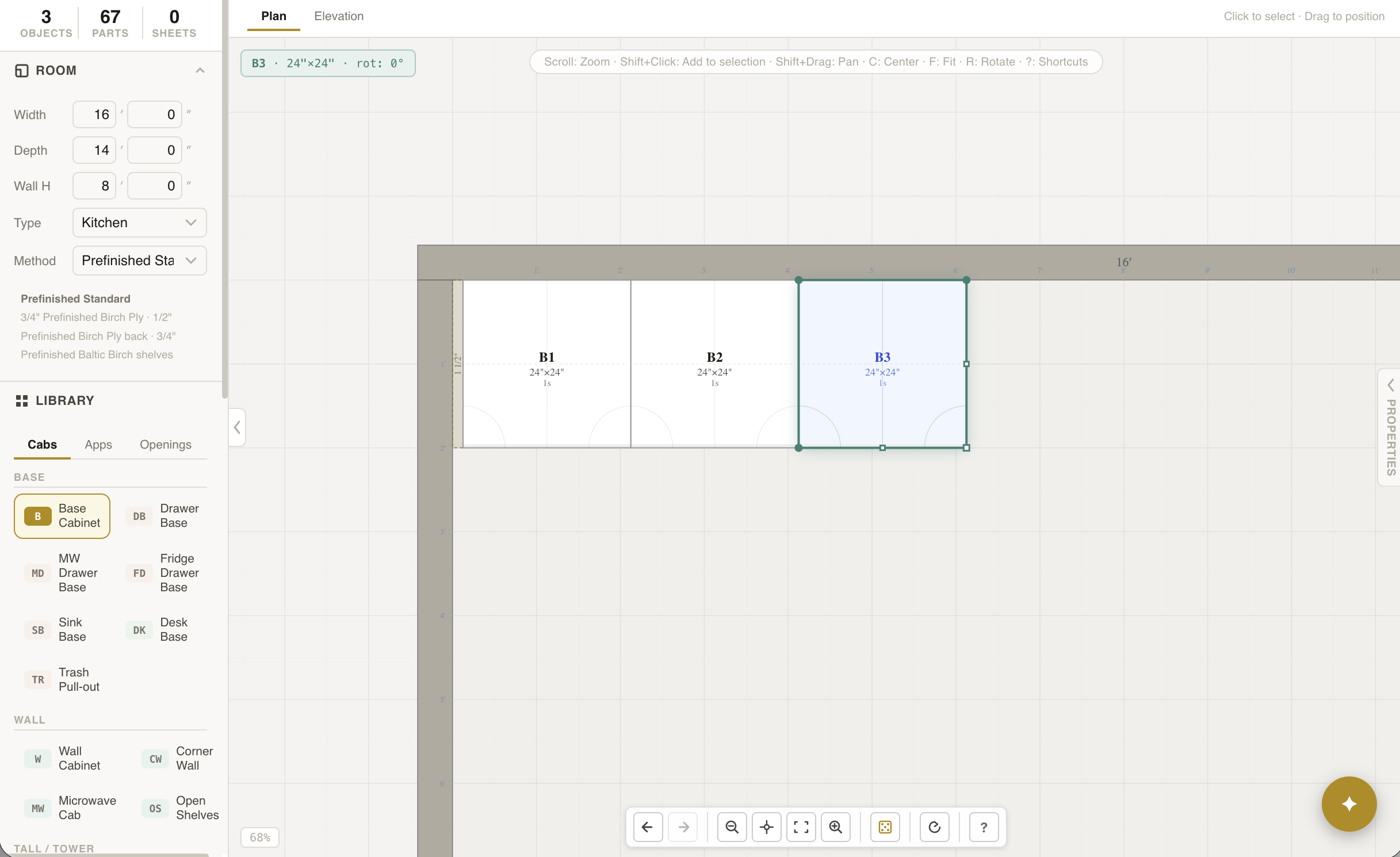
Cabora's canvas — place cabinets, see real dimensions, no drafting training required.
- The costly mistakes in DIY cabinet builds happen in planning, not execution
- Professional software has a learning curve that doesn't make sense for a one-time build
- A good plan answers: exact dimensions, piece relationships, material quantities
- Cabora is designed for people who aren't full-time designers — no training required